


Two shipments leave the same warehouse, same day, same destination — and one costs twice the other to fly. The difference usually isn't the airline. It's that one shipper understood how air freight is priced and the other paid for air they didn't need. If air freight cost in Saudi Arabia has ever surprised you on the invoice, this guide is why.
We're BAFCO International — 30 years moving air, sea and land freight across Jeddah, Riyadh, Dammam and Jubail. Below is exactly how airlines and forwarders build a rate, the 7 factors that decide what you pay, the service tiers to choose from, and when paying for air actually saves money.
Request an air freight quote from BAFCO — real numbers for your cargo, not a range.
First: chargeable weight (the thing that surprises everyone)
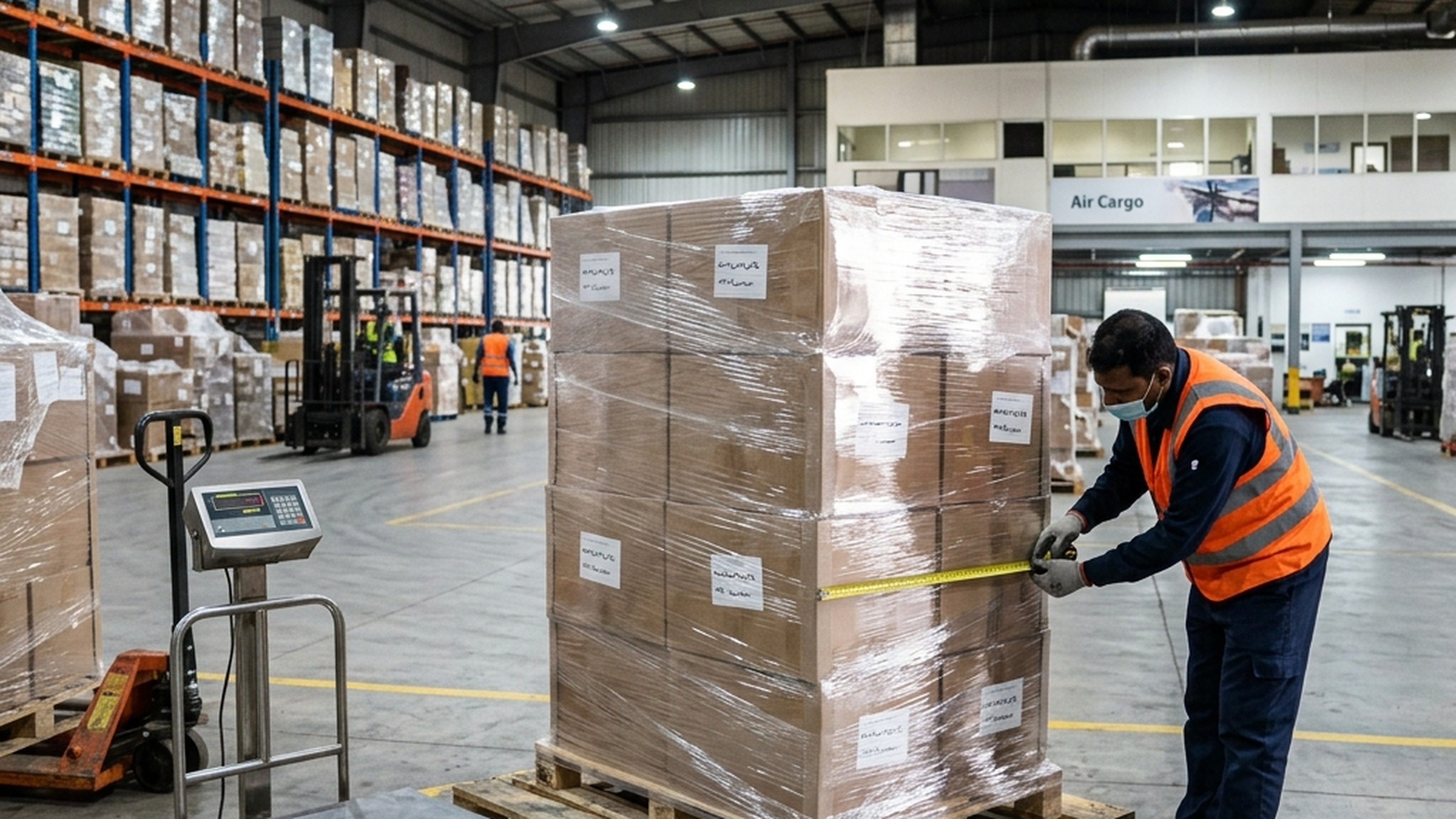
Air freight isn't priced on what your shipment weighs on a scale. It's priced on chargeable weight — the *greater* of actual (gross) weight and volumetric (dimensional) weight. Airlines sell both space and payload, so light-but-bulky cargo is charged on the room it occupies, not just its mass.
Volumetric weight (kg) = L × W × H (cm) ÷ 6000 — equivalently, 1 CBM ≈ 167 kg of chargeable weight.
Worked example 1: a carton 100 × 80 × 60 cm weighing 40 kg.
Volume = 480,000 ÷ 6000 = 80 kg volumetric; actual = 40 kg → you're charged on 80 kg.
Worked example 2: a dense machine part 40 × 40 × 40 cm weighing 55 kg.
Volume = 64,000 ÷ 6000 = 10.7 kg volumetric; actual = 55 kg → you're charged on 55 kg.
The lesson: for bulky-but-light cargo, re-packing into smaller, denser cartons directly lowers the chargeable weight — and the bill. Understand this one rule and half of air freight's "surprises" disappear.
What air freight actually costs (indicative 2026)
- Within Saudi Arabia / regional: roughly SAR 13–22 per kg, moving with fuel surcharges and route demand.
- Long-haul (e.g. US ↔ KSA): about USD 3–8 per kg for general cargo before surcharges — and, importantly, the per-kg rate drops as the shipment gets heavier, with cheaper breaks typically at +45 kg, +100 kg, +300 kg, +500 kg and +1,000 kg.
That weight-break structure is why consolidating shipments — or using a forwarder that already moves volume on your lane — can meaningfully cut your rate. *(Indicative market ranges — ask BAFCO for a live quote.)*
How an air freight rate is built
A quote is a base rate plus add-ons. The base rate is per kg of chargeable weight at your weight break. On top sit the fuel surcharge and security surcharge (both per kg, moving independently of the base rate), plus airport terminal handling, customs clearance fees, and any special-handling charges. On imports you then add customs duty and 15% VAT. A door-to-door quote also includes pickup and last-mile delivery. Always ask for these itemised — an "airport-to-airport" headline rate hides several of them.
The 7 factors that decide your air freight cost
- Chargeable weight — the foundation of every quote. Reduce volume, reduce cost.
- Lane (origin–destination) — rates are per-kg by route and swing with capacity and demand; cargo out of Jeddah (JED) and Riyadh (RUH) to major hubs is well-served, while thin or one-way lanes cost more.
- Service level — express/direct is fastest and priciest; standard airport-to-airport is the balance most freight uses; consolidation is cheapest per kg (see tiers below).
- Fuel & security surcharges — real, per-kg, and separate from the base rate; always get them itemised.
- Cargo type & handling — dangerous goods, temperature-controlled pharma, valuables and oversized pieces each need special handling, documentation and packaging, and each adds cost.
- Customs duty, VAT & clearance — duty (by HS code) and 15% VAT on imports, plus fees; slow clearance also triggers daily airport storage. See customs clearance.
- Airport handling, storage & door delivery — terminal handling, any storage before pickup, and last-mile delivery to Riyadh or Dammam all sit in the final figure.
Model the base numbers before you book with our air freight charges calculator.
Air freight service tiers — pick the right speed
| Tier | Speed | Best for |
|---|---|---|
| Express / direct | Fastest — direct flights, priority | Critical spares, samples, tight deadlines |
| Standard (airport-to-airport) | Fast, scheduled | Most general air cargo |
| Consolidated | A little slower — shared master airway bill | Cost-sensitive shipments; a forwarder's volume earns a better per-kg rate |
| Charter | On-demand whole aircraft | Very large, urgent or oversized project cargo |
Choosing a tier one notch slower than "express by default" is often the single easiest saving — if your lead time allows it.
Special cargo — where costs (and rules) change
Not all air cargo is equal. Dangerous goods (batteries, chemicals, aerosols) need IATA DGR-compliant packing, labelling and documentation. Pharma and perishables need temperature-controlled handling and fast clearance. Valuables need secure handling. Oversized or heavy pieces may need special loading or a freighter rather than belly-hold space. Declaring cargo correctly up front avoids penalties, delays and re-handling later — a forwarder's job is to classify it right the first time.
When air is worth the premium
Air costs several times more per kg than sea — but the freight rate isn't the whole equation. Air wins when the cost of waiting outweighs the cost of flying:
| Choose air when… | Why |
|---|---|
| Stock-outs are costing sales | Days of air beat weeks of lost revenue |
| Production is waiting on a part | A stalled line costs more per day than the freight |
| Goods are perishable/time-sensitive | Pharma, food, samples, seasonal stock |
| Value-to-weight is high | Electronics, spares — freight is a small % of value |
| It's a one-off urgent top-up | Sea for the bulk, air for the gap |
For the full sea comparison, see sea freight from Saudi Arabia. The smart play is usually a mix, not a religion.
5 ways to cut your air freight bill
- Re-pack to kill volumetric weight — denser, smaller cartons lower chargeable weight directly.
- Consolidate — combine shipments, or use a forwarder's consolidation service for a better per-kg rate and weight break.
- Plan ahead — express exists because someone didn't; lead time lets you use cheaper standard service.
- Clear it right the first time — correct HS codes and documents avoid daily airport storage and penalties.
- Right-size the service tier — don't pay for express when standard makes the deadline.
How long does air freight take from Saudi Arabia?
Air is measured in days, not weeks. Airport-to-airport, most major lanes from Jeddah (JED) and Riyadh (RUH) move in a 1–5 day window — express/direct services at the fast end, consolidated services a little slower. Total door-to-door time then depends on two things the air rate doesn't show: customs clearance and last-mile delivery. Clear the cargo cleanly and deliver locally and the whole journey stays tight; hit a documentation problem and days of airport storage undo the speed you paid for — which is why fast, correct clearance is as much a part of "air freight" as the flight itself.
Air cargo gateways: Jeddah, Riyadh and Dammam
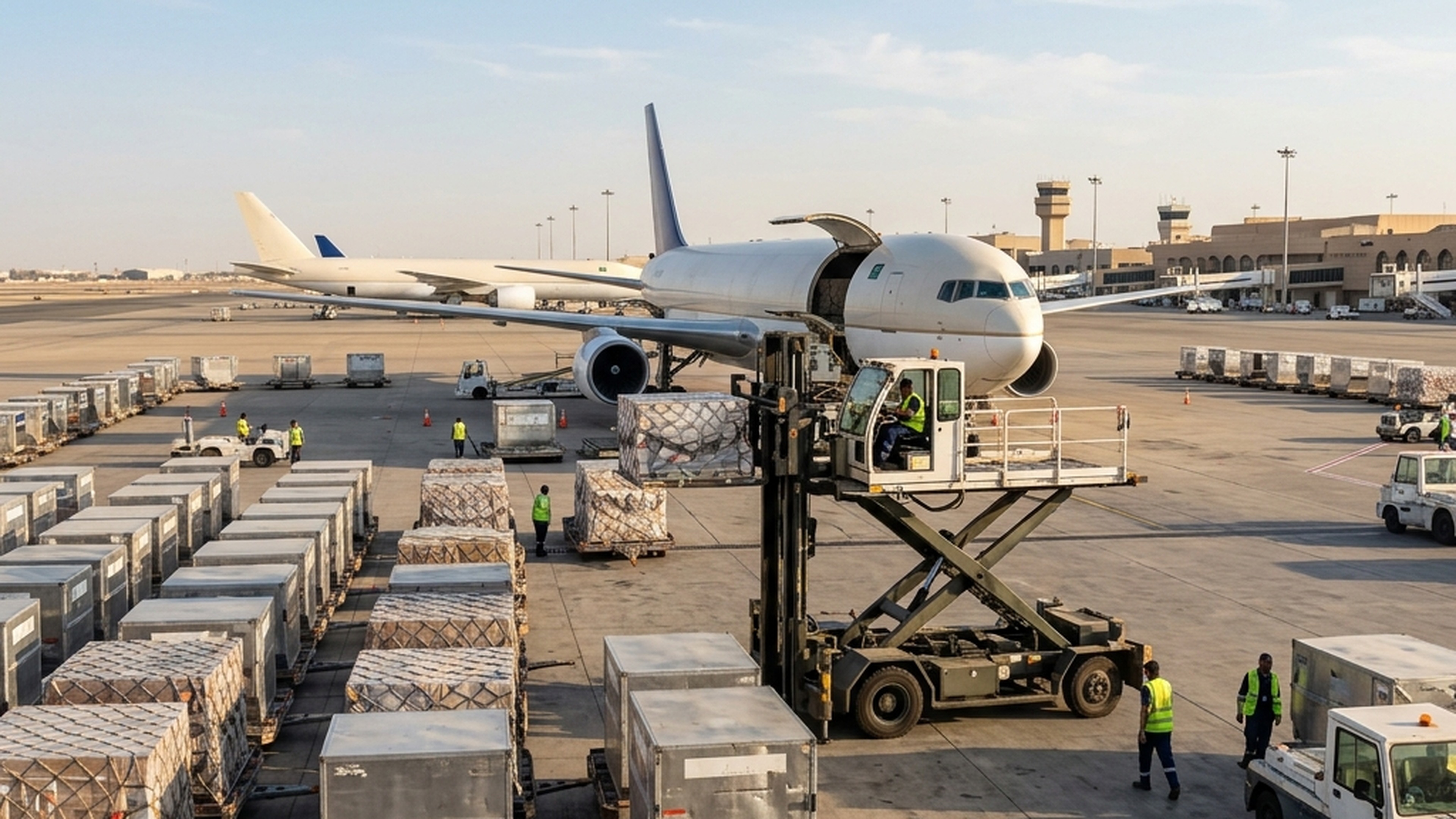
Saudi Arabia's three main air-cargo gateways each serve a region: King Abdulaziz International Airport (JED) in Jeddah for the western region and the largest air-cargo volumes; King Khalid International Airport (RUH) in Riyadh for the central market and national distribution; and King Fahd International Airport (DMM) in Dammam for the Eastern Province and the industrial/energy belt. Cargo moves both in the belly-hold of passenger aircraft and on dedicated freighters — freighters take heavier, larger or urgent volumes, belly space suits smaller general cargo — and a forwarder with access to both gets you options when one is tight.
Documents you'll need for air freight
The core set is the Air Waybill (AWB) — the contract of carriage and the shipment's key reference — plus the commercial invoice and packing list, and, for Saudi imports, SABER/SASO conformity and the correct HS code. Dangerous goods add a Shipper's Declaration; some goods need a certificate of origin or specific permits. Getting this pack right up front is what keeps cargo flowing through the airport instead of sitting in storage.
Is air cargo insured?
An airline's liability for lost or damaged air cargo is limited by weight under international convention — often far below what your goods are actually worth. For anything valuable, arrange separate all-risk cargo insurance sized to the real value; the premium is small against the exposure, and a forwarder can arrange it as part of the booking.
Can you track an air shipment?
Yes — every air shipment moves under an Air Waybill (AWB) number you can use to follow it from acceptance at origin, through each transit point, to arrival and clearance. A good forwarder doesn't leave you refreshing a tracking page, though — they monitor the milestones and flag any exception (a missed connection, a customs query) before it becomes your problem.
Why BAFCO for air freight in Saudi Arabia
BAFCO combines airline relationships and consolidation volume with in-house customs clearance and nationwide delivery — so you get competitive chargeable-weight rates *and* cargo that clears and reaches the door without airport storage creeping onto the invoice. Thirty years, four branches, one accountable chain. See how we compare in our 10 best freight forwarders in Saudi Arabia guide.
Frequently asked questions
How is air freight cost calculated in Saudi Arabia?
On chargeable weight — the greater of actual and volumetric weight (L×W×H cm ÷ 6000) — plus fuel and security surcharges, handling, customs duty and 15% VAT on imports, and any door delivery.
What does air freight cost per kg in Saudi Arabia?
Indicatively, regional/domestic air runs around SAR 13–22 per kg, while long-haul lanes such as US–KSA are roughly USD 3–8 per kg before surcharges, dropping at higher weight breaks (300 kg+, 500 kg+, 1,000 kg+).
What is chargeable weight?
The figure you're billed on: whichever is greater, actual (gross) weight or volumetric weight. Bulky-but-light cargo is charged on the space it occupies.
Why is my air freight more than the cargo's actual weight?
Because volumetric weight is higher than scale weight for bulky cargo — you're charged on the higher number. Denser packing usually reduces it.
Is air much more expensive than sea freight from Saudi Arabia?
Per kg, yes — several times more. But when stock-outs, stalled production or perishables make waiting expensive, air can be the cheaper *total* decision.
What adds hidden cost to an air quote?
Fuel and security surcharges, special handling, airport storage if clearance is slow, customs duty and VAT, and last-mile delivery. Always compare on a door-to-door basis.
