
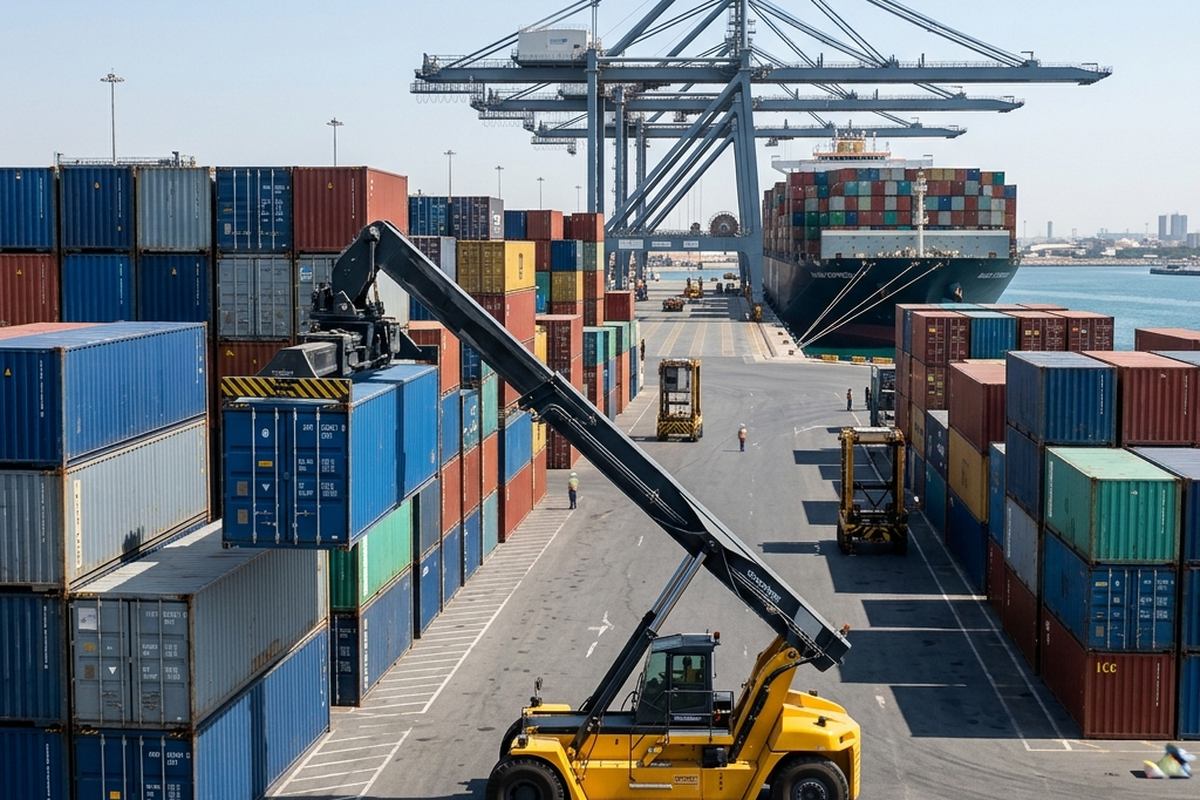
Jeddah Islamic Port is the front door to Saudi Arabia. It handles the lion’s share of the Kingdom’s container trade, sits on the Red Sea a short hop from the Suez–Bab-el-Mandeb lane, and — after regional disruptions pushed even more volume onto Red Sea routings through 2026 — it has rarely been busier. That is both the opportunity and the trap: the port rewards importers who prepare, and quietly punishes those who improvise.
We’re BAFCO International. We’ve cleared and moved cargo through Jeddah for 30 years, from a head office minutes from the quay. Below are 7 insider tips we give our own clients — the practical, order-of-operations details that decide whether your container clears in a few days or racks up demurrage for a week. Work them into your next shipment yourself, or hand them to a seasoned freight forwarding company in Jeddah to run on your behalf.
Short on time? Talk to BAFCO’s Jeddah clearance team and we’ll walk your shipment through every step below.
Why Jeddah Port rewards preparation
Jeddah Islamic Port moves millions of TEU a year and is mid-way through a multi-billion-riyal modernisation with global terminal operators — part of the wider Vision 2030 push to make the Kingdom a logistics hub between three continents. More capacity is coming, but so is more volume. In practice that means berths, yards and customs lanes run hot, and the difference between a smooth clearance and an expensive one is almost always what you did before the vessel arrived — not what you do after.
Here are the seven things that matter most, strongest first.
The 7 insider tips for shipping through Jeddah Port
1. File the Bayan early — pre-clear before the vessel berths
This is the single biggest lever you have. Your free time at Jeddah is short, and it only starts on your side if the paperwork is already moving.
- Why it matters: Carriers and the port typically allow around 3 days of free time to clear cargo off port premises — but only if the Bayan (import declaration) is filed within about 3 days of the vessel’s arrival. Miss that, and demurrage can be calculated from the arrival date itself, wiping out your buffer before you’ve even started.
- How to do it: Submit your customs declaration through the FASAH single-window platform before the ship lands — the system lets brokers lodge declarations ahead of arrival, and many importers pre-file at least 48 hours before berthing. Get your commercial invoice, packing list and Bill of Lading to your broker early so the Bayan is ready to release the moment the vessel is alongside.
2. Get the HS code right — one wrong digit can trigger a Red-Track hold
Incorrect classification is the most common reason Jeddah shipments stall, and it is entirely self-inflicted.
- Why it matters: A wrong HS code can mean the wrong duty rate, a mismatch against your SABER certificate, or an automated flag at the port. Declarations that don’t add up get pushed to the Yellow Track (document check) or Red Track (physical inspection) — and a Red-Track inspection typically adds 2–5 business days, plus storage and handling, on top of your clearance time. Misdeclaration penalties can reach SAR 5,000+, and where duty is under-paid, ZATCA can levy fines of up to three times the evaded amount.
- How to do it: Classify against the current ZATCA 12-digit HS code (the platform rejects the old code from 2026), and make sure the code on your declaration, your invoice and your SABER certificate all match. When in doubt, have a licensed customs broker confirm classification before you ship — it is far cheaper than an inspection hold.
3. Pre-arrange SABER — the Shipment Certificate is now mandatory before your declaration
For most regulated consumer products you cannot clear Jeddah without SABER, and the rules tightened recently.
- Why it matters: Under SABER (the SASO conformity platform), regulated goods need a Product Certificate of Conformity (PCoC) and, per shipment, a Shipment Certificate of Conformity (SCoC). Since 1 October 2025 the SCoC must be issued before the customs declaration is raised — no valid SABER, no clearance, and non-conforming cargo can be rejected and re-exported at your cost.
- How to do it: Register your product for a PCoC (valid ~1 year) well ahead of your first shipment, then obtain an SCoC for each consignment before it sails. Confirm which of your products are regulated before booking — arranging SABER after the box has landed is the classic way to burn your free time.
4. Know Jeddah’s free-time and demurrage windows — and beat the clock
Treat free time as a countdown, not a cushion. Once it lapses, the charges stack quickly.
- Why it matters: After free time expires, demurrage (the box sitting at the terminal) and detention (you holding the carrier’s container) accrue per container, per day — Jeddah figures commonly land in the SAR 150–500 per container per day range, and they escalate in tiers the longer cargo sits. Port storage piles on top, and cargo left uncleared for 15–30 days can be treated as abandoned. Published port tariffs sit with Mawani, the Saudi Ports Authority.
- How to do it: Line up onward delivery or warehousing before arrival so boxes move off the quay immediately, and work with a forwarder that has owned container terminals and in-house clearance staff who can act the day the vessel berths.
Here’s the Jeddah timeline our team plans against:
| Stage | Typical window at Jeddah | What it means for you |
|---|---|---|
| Bayan filing (pre-clear) | From ~48 hrs before vessel arrival | File early to protect your free time |
| Port free time | ~3 days from arrival to clear cargo off premises | Applies only if the Bayan is filed within ~3 days of arrival |
| Carrier detention free time | ~5–7 days on the container | Return the empty before detention starts |
| Demurrage / detention | ~SAR 150–500 per container / day, tiered | Escalates the longer the box sits — avoidable |
| Port storage | On top of demurrage | Bonded/managed warehousing is far cheaper |
| Abandonment risk | ~15–30 days uncleared | Cargo can be treated as abandoned |
Illustrative windows; exact free time and demurrage tariffs vary by shipping line and contract — confirm yours before the vessel sails.
5. Plan around peak, Ramadan and Eid congestion
The Saudi calendar has predictable pinch points. Landing cargo into one is expensive.
- Why it matters: Around Eid al-Adha (which fell in late May in 2026) customs and government offices close for several days, and with the surrounding weekend and post-holiday backlog the effective disruption for clearance-dependent cargo can stretch to 7–10 working days. Ramadan runs on reduced hours, and general spring/summer peaks plus 2026’s Red Sea re-routings have at times pushed Jeddah dwell times well into double digits. Demurrage doesn’t pause for a public holiday.
- How to do it: Build a buffer into transit and clearance plans around known holidays, avoid scheduling arrivals to land just before a closure, book space early into peak windows, and keep documents 100% ready so your cargo is first in the queue when offices reopen.
6. Consolidate LCL smartly — and know when FCL wins
Paying for space you don’t use, or consolidating badly, both cost money at Jeddah.
- Why it matters: For smaller volumes, LCL (less-than-container-load) sharing a box is far cheaper than an under-filled FCL — but a poorly consolidated LCL group can invite extra handling and inspection if one shipper in the container has a problem declaration. As your volume grows, there’s a break-even point (often around 13–15 CBM) where a dedicated FCL becomes cheaper and lower-risk than LCL.
- How to do it: Consolidate through a Jeddah forwarder that runs regular, well-documented LCL boxes on your lane, so you share clean containers with reliable co-loaders — and switch to FCL once your volume justifies it. Ask your forwarder to model both against your actual CBM and deadline.
7. Use a Jeddah-based forwarder with real port relationships and owned terminals
Every tip above is easier when the people running it are already at the port.
- Why it matters: A local, in-house team hears about berth changes, customs updates and inspection flags in real time and can react the same day. An asset-backed forwarder with owned terminals, warehousing and its own transport moves your box off the quay before the demurrage meter runs — instead of sub-contracting each leg at a markup and losing a day at every handover.
- How to do it: Choose a forwarder with a genuine Jeddah presence, in-house customs clearance, and coverage across the Kingdom’s main hubs. That’s exactly how BAFCO operates as a freight forwarding company in Jeddah — HQ at the port, branches in Riyadh, Dammam and Jubail, owned container terminals and 100,000+ of warehousing behind every shipment.
Documents to have ready before your vessel berths
Most Jeddah delays trace back to a missing or mismatched document. Have these lined up before arrival:
| Document | Why Jeddah customs needs it | Get it ready |
|---|---|---|
| Commercial invoice | Declared value for duty + 15% VAT | From supplier, before shipping |
| Packing list | Verifies contents against the declaration | Match line-for-line to the invoice |
| Bill of Lading / Air Waybill | Title and cargo release | From carrier / forwarder |
| Certificate of Origin | Duty rate and GCC preference | Attested where required |
| SABER SCoC (+ PCoC) | Mandatory before the customs declaration | Via saber.sa, per shipment |
| HS code (ZATCA 12-digit) | Drives duty rate and clearance channel | Confirm with your broker |
| Importer CR & VAT details | Needed for the ZATCA declaration | Keep importer records to hand |
Why a Jeddah forwarder pays for itself
None of these delays are bad luck — they’re information and timing gaps, and every one of them is avoidable. A forwarder clearing cargo through Jeddah every day pre-files the Bayan, gets the HS code and SABER right the first time, and moves the box before the free time lapses. With 30 years at Jeddah Islamic Port, owned container terminals, in-house customs teams and branches across the Kingdom, BAFCO turns the port’s busy, rules-heavy reputation into a routine, on-time clearance.
If you’re comparing options, our guide to freight forwarding services in Saudi Arabia and our 10 best freight forwarders in Saudi Arabia round-up give you the wider picture, and for recurring flows there’s our 3PL companies in Saudi Arabia breakdown.
Frequently asked questions
What is the free time at Jeddah Islamic Port before demurrage starts?
Typically around 3 days to clear cargo off port premises — but that free time is protected only if the Bayan (import declaration) is filed within about 3 days of the vessel’s arrival. Carriers usually allow roughly 5–7 days before container detention begins. Miss the filing window and demurrage can be charged from the arrival date. Exact figures vary by shipping line and contract.
When should I file the Bayan for a shipment into Jeddah?
As early as possible — ideally before the vessel arrives. The FASAH single-window platform lets brokers lodge the import declaration ahead of berthing, and many importers pre-file at least 48 hours before arrival so cargo can be released the moment it lands.
Do I need a SABER certificate to clear customs at Jeddah Port?
For most regulated consumer products, yes. You need a Product Certificate of Conformity (PCoC) and, per shipment, a Shipment Certificate of Conformity (SCoC) via the SABER platform. Since 1 October 2025 the SCoC must be issued before the customs declaration — arrange it before you ship, never after arrival.
How long does customs clearance take at Jeddah Islamic Port?
Standard clearance is commonly 3–7 business days. With documents pre-filed, a registered broker and a bonded warehouse, that can drop to 1–3 days. A physical (Red-Track) inspection or an SFDA check on food can add 2–5 days more.
What happens if my HS code is wrong on a Saudi customs declaration?
A wrong HS code can push your shipment to the Yellow Track (document check) or Red Track (physical inspection), adding 2–5 business days plus storage. It can also mean the wrong duty and penalties — misdeclaration fines can reach SAR 5,000+, and ZATCA can charge up to three times any evaded duty. Confirm classification before you ship.
How do I avoid port congestion delays at Jeddah during Ramadan and Eid?
Build a buffer around known closures, avoid landing cargo just before a holiday, book space early into peak windows, and keep every document ready so you clear first when offices reopen. Around Eid, effective disruption for clearance-dependent cargo can stretch to 7–10 working days.
Is LCL or FCL cheaper for shipping through Jeddah?
For smaller volumes, LCL (sharing a container) is usually cheaper than an under-filled FCL. As volume grows there’s a break-even point — often around 13–15 CBM — where a dedicated FCL becomes both cheaper and lower-risk. Ask your forwarder to model both against your actual cargo and deadline.
Why use a freight forwarding company in Jeddah instead of an overseas forwarder?
A Jeddah-based, asset-backed forwarder hears about berth, customs and inspection changes in real time and can act the same day — pre-filing the Bayan, clearing in-house and moving your box off the quay before demurrage starts. Overseas-only forwarders sub-contract each Saudi leg, adding markups and delay at every handover.
Related reads
- Everything You Need to Know About Freight Forwarding Services in Saudi Arabia
- 10 Best Freight Forwarders in Saudi Arabia for Hassle-Free Shipping
- 9 Hidden Costs of Freight Forwarding in Saudi Arabia (2026)
- Freight Forwarders in Jeddah
Ship through Jeddah without the surprises
Send BAFCO your shipment details and our Jeddah team will pre-file the Bayan, sort SABER and clearance, and move your cargo off the port before demurrage ever starts — with 30 years of Jeddah Islamic Port experience behind every box.
📞 +966 12 642 0333
📧 inquiry@bafcointl.com
🚢 Request a shipping quote
📍 Jeddah HQ · Branches in Riyadh, Dammam & Jubail